


How to Start an Online Gaming Business in 2026
Posted on: January 28, 2026
Category: Company Formation , eGaming , Gaming , Online Business
Author: Gilad Oren











What It Really Takes to Launch an Online Gaming Business
Starting an online gaming business in 2026 means navigating licensing, banking, software, and compliance in the right order. Startup costs typically range from €42,000 to €150,000+, depending on your jurisdiction and whether you launch via a white label or a turnkey platform. Some operators can go live in weeks; others need months. This guide breaks down the real costs, timelines, and decisions that determine whether you launch smoothly or get stuck before accepting your first deposit.
Key Takeaways
-
Starting an online gaming business in 2026 typically costs €42,000 to €150,000+, depending on license and software model
-
White-label casinos can launch in as little as 2-4 weeks, while turnkey platforms take 3–12 months
-
License choice affects everything: banking access, payment providers, credibility, and timelines
-
Banking and PSP setup are critical path items and should never be left until the end
-
White label suits first-time or budget-conscious operators; turnkey fits long-term, high-control strategies
-
Compliance, software stability, and realistic marketing budgets determine whether you stay live, not just whether you launch
-
GBO provides end-to-end support covering licensing, company setup, banking, payments, and software
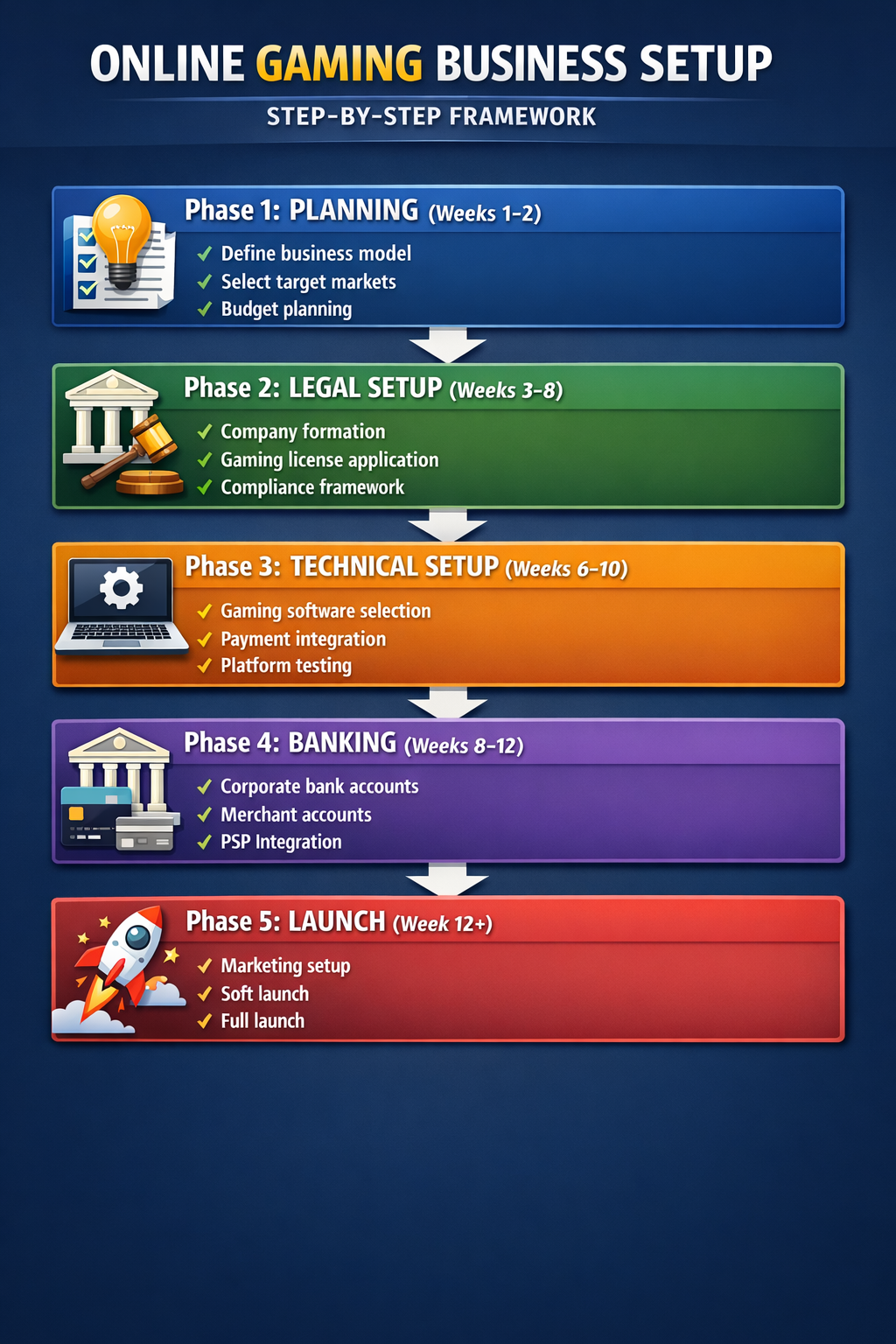
Complete Roadmap: Starting Your Online Gaming Business in 2026
Phase 1: Planning (Weeks 1-2)
- Define business model
- Select target markets
- Budget planning
Phase 2: Legal Setup (Weeks 3-8)
- Company formation
- Gaming license application
- Compliance framework
Phase 3: Technical Setup (Weeks 6-10)
- Gaming software selection
- Payment integration
- Platform testing
Phase 4: Banking (Weeks 8-12)
- Corporate bank accounts
- Merchant accounts
- PSP integration
Phase 5: Launch (Week 12+)
- Marketing setup
- Soft launch
- Full launch
Need help with licensing, banking, or software? GBO can assist
Step 1: Choose Your Online Gaming Business Model
Before you look at licenses, software, or payment providers, you need to be clear on how you’re actually going to make money. Your business model determines everything that follows: your budget, your risk exposure, your timeline to launch, and how much operational control you’ll have once you’re live.
At a high level, there are four common ways to enter the online gaming industry. You can operate a player-facing casino under your own brand, launch via a white label arrangement under a master license, focus purely on player acquisition as an affiliate, or build and sell gaming technology as a B2B software provider. Each model comes with different cost structures, risk profiles, and operational demands, and the right choice depends on your capital, experience, and long-term goals.
B2C Online Casino (Player-Facing)
This is the classic operator model. You run a branded online casino, acquire players directly, and keep the full gaming revenue generated on your platform.
How it works
You hold your own gaming license, contract the software and payment providers directly, and take responsibility for marketing, compliance, and day-to-day operations. Your revenue comes from the house edge, typically around 3–5% of gross gaming revenue (GGR).
What you need
- A gaming license in a jurisdiction accepted by banks and PSPs
- Casino software (white label or turnkey)
- Corporate banking and payment processing
- A meaningful marketing budget to acquire players
Why operators choose this model
- Full control over branding, player experience, and commercial strategy
- No revenue sharing with a master operator
- Highest long-term profit potential once scale is reached
Where it becomes challenging
- Player acquisition is competitive and expensive
- Marketing costs are ongoing, not one-off
- You carry full regulatory, compliance, and operational responsibility
Best fit for you if:
You’re working with a budget of €100,000 or more, you understand digital marketing or affiliate acquisition, and you’re building for long-term ownership rather than a quick market entry.
B2B White Label Casino
A white-label casino lets you enter the market faster by operating under an existing master license and infrastructure, in exchange for a share of revenue.
How it works
You launch a casino using a pre-built platform provided by a licensed master operator. Your brand sits on top of their license, software stack, and payment integrations. Revenue is split (usually 20–50% of net gaming revenue), depending on the agreement.
What you need
- A white label or master license agreement
- Significantly less upfront capital
- Basic branding and marketing setup
Why operators choose this model
- Lower startup cost, typically €20,000–€40,000
- Much faster launch timeline, often 2–4 weeks
- Minimal technical or regulatory complexity
Where it becomes limiting
- Ongoing revenue sharing reduces margins
- Limited control over platform features and roadmap
- Harder to differentiate long-term
Best fit for you if:
You’re launching your first gaming business, working with a limited budget, or want to validate a market quickly before committing to a full license and standalone operation.
Affiliate / Partner Model
If you don’t want to operate a casino at all, the affiliate or partner model lets you participate in the gaming industry purely as a traffic and acquisition business.
How it works
You drive players to already licensed online casinos and earn a commission when those players register or generate revenue. You don’t handle payments, compliance, or player accounts. Your role is acquisition.
Revenue structure
- CPA (cost per acquisition): typically €50–€300 per player
- Revenue share: usually 25–40% of the player’s net gaming revenue over time
What you need
- No gaming license
- Strong marketing capability (SEO, paid media, content, or media buying)
- Relationships with licensed operators or affiliate networks
Why operators choose this model
- Lowest barrier to entry in terms of cost
- No regulatory or compliance obligations
- Fast to start and easy to test multiple markets
Where it becomes limiting
- Margins are lower than operating your own casino
- Revenue depends entirely on partner terms and tracking accuracy
- You have no control over player experience or retention
Best fit for you if:
You’re primarily a marketer, you want exposure to the gaming industry without regulatory complexity, or you’re testing the space before moving into operating your own platform.
Need help? GBO can guide your gaming business setup from start to launch
Software Provider (B2B SaaS)
This model flips the equation entirely. Instead of operating a casino, you provide the technology that other operators use to run theirs.
How it works
You develop or own a gaming platform and sell it to operators as a service. This can include white label platforms, turnkey solutions, payment integrations, or back-office tools. Revenue comes from setup fees, monthly platform fees, and sometimes revenue share.
Revenue structure
- One-time setup or onboarding fees
- Recurring monthly platform fees
- Optional revenue share depending on the offering
What you need
- Significant software development capability
- Gaming licenses or regulatory approvals (depending on scope)
- Scalable infrastructure and long-term support resources
Why companies choose this model
- Highly scalable once the platform is established
- Predictable, recurring revenue
- Less exposure to player acquisition costs
Where it becomes challenging
- High upfront development and compliance costs
- Long time to market before revenue
- Extremely competitive landscape with established providers
Best fit for you if:
You already have a strong technical team, understand gaming compliance, and are building a long-term B2B product rather than a player-facing brand.
Step 2: Select Your Gaming License Jurisdiction
Selecting a gaming license is one of the decisions that will shape everything that follows, from your costs and launch timeline to your access to banking and payment providers. Annual licensing fees can range from around €15,000 to well over €100,000, so the jurisdiction you choose needs to match both your budget and your target markets. Malta is typically used for European-facing operations, Anjouan and Nevis for Asia, and Curaçao or Nevis for broader global coverage.
Banking is a critical factor as well, with Nevis and Curaçao generally offering higher acceptance rates with PSPs. In terms of regulatory reputation, Malta sits at the top, followed by Nevis and Curaçao, with Anjouan positioned as a faster, lower-cost option.
| Jurisdiction | Cost | Timeline | Best For |
|---|---|---|---|
| Nevis | €38,000 | 8-12 weeks | Balanced (speed + reputation) |
| Curacao | €34-44,000 | 4-6 weeks | Established operators |
| Anjouan | €21,500 | 2-3 weeks | Budget startups |
| Malta | €55-130,000+ | 6-12 months | Premium markets |
Step 3: Form Your Gaming Company
Once you’ve selected your license jurisdiction, you need a legal entity that can hold the license, open bank accounts, and contract software and payment providers. This step is procedural, but accuracy matters; mistakes here tend to slow everything that follows.
What your gaming company must have:
- A registered office in the license jurisdiction
- A local director or registered agent, where required
- Proper company registration documents
- KYC and AML documentation for all directors and ultimate beneficial owners (UBOs)
- A designated compliance officer (this role can usually be outsourced)
Documents you’ll need to provide:
- Notarized passport copies for directors and UBOs
- Proof of address (recent utility bill or bank statement)
- A basic business plan outlining your gaming activity
- A source of funds declaration
- Criminal background checks, if required by the jurisdiction
Timeline and cost
If your documentation is ready and consistent, company formation typically takes 1–2 weeks and can be completed remotely. Costs usually range from €3,000 to €10,000, depending on the jurisdiction and local requirements.
Step 4: Choose Gaming Software (White Label vs Turnkey)
At this stage, you’re deciding how your platform will actually run day to day. Your software choice affects how quickly you can launch, how much flexibility you’ll have post-launch, and how your costs scale as revenue grows. For most operators, the decision comes down to white label versus turnkey.
White Label Gaming Software
A fully built gaming platform that you launch under your own brand. The core technology, hosting, game integrations, and platform updates are handled by the provider, which means you don’t need to build or maintain technical infrastructure. Your focus stays on branding, player acquisition, compliance oversight, and day-to-day operations rather than development and system maintenance.
Cost and timeline
- Setup cost: €20,000–€50,000
- Ongoing: 15–30% revenue share
- Launch timeline: 2–4 weeks
What’s included
- 10,000+ casino games from multiple providers
- Integrated payment methods and PSP connections
- Player management, reporting, and back-office tools
- Hosting, maintenance, and platform updates
Pros
- Fastest way to enter the market
- Lower upfront capital requirement
- No need for in-house developers or technical staff
- Proven, already-tested infrastructure
Cons
- Revenue sharing impacts long-term margins
- Customisation is limited to branding and allowed configurations
- You depend on the provider’s roadmap and technical decisions
Best for: First-time operators with a budget under €50,000 who want to launch quickly, validate demand, and start generating revenue without technical complexity.
Turnkey Gaming Solution
A custom-built gaming platform developed specifically for your business, where you own the software and the underlying architecture. You control all features, integrations, data flows, and user experience, and you decide how the platform evolves over time, whether that means adding proprietary functionality, integrating new payment methods, or adapting the product as regulations and markets change.
Cost and timeline
- Cost: €100,000–€500,000+ depending on scope and features
- Development timeline: 3–6 months
What’s included
- Custom platform design and architecture
- Proprietary features and workflows
- Full control over game providers, payments, and data
- Independent infrastructure and integrations
Pros
- Full ownership of the platform and IP
- Unlimited flexibility in features and user experience
- No mandatory revenue sharing
- Better long-term economics once you scale
Cons
- High upfront investment
- Longer time before launch and revenue
- Responsibility for ongoing maintenance and upgrades
Best for: Established operators with budgets above €150,000 who are building a long-term business and want full control over technology, margins, and differentiation.
Start your gaming business the right way with GBO
Step 5: Set Up Banking and Payment Processing
Treat this step like a launch blocker: if you can’t bank and you can’t take deposits, you can’t operate, even if your license and software are ready. Here’s the clean order to do it in.
Corporate Bank Account
You need a corporate bank account to run the business itself. This is the account you’ll use to receive operating funds and pay suppliers such as software providers, service partners, staff, and ongoing administrative costs.
Step 1: Get your bank pack ready (before you apply).
You’ll typically need three things: your gaming license, your company documents, and a business plan that clearly explains what you’re doing (jurisdiction, model, target markets, how payments flow, and who the owners are).
Step 2: Apply to a bank that actually supports gaming.
Gaming is classified as high risk, so many mainstream banks will reject you automatically. Don’t waste weeks applying to institutions that don’t touch gaming.
Step 3: Expect compliance checks and back-and-forth.
Even gaming-friendly banks will ask follow-up questions (ownership, source of funds, business model, expected volumes). This is normal. Answer quickly and consistently.
Step 4: Plan for a 2–4 week timeline.
From submission to approval, 2–4 weeks is typical if your documents are clean and your structure makes sense.
Because gaming is classified as high risk, many traditional banks will simply refuse these accounts. GBO works with a network of gaming-friendly banks in Europe, which significantly reduces rejection rates and prevents you from losing time applying to banks that won’t support gaming operations.
Merchant Account / PSP Integration
This is what lets you accept player deposits via credit cards, e-wallets, bank transfers, and crypto, and run payouts reliably.
Step 1: Decide what payment methods you need based on your markets.
You can technically offer 500+ methods, but you should choose what matters for your target regions, cards, local bank transfers, e-wallets, and (if relevant) crypto.
Step 2: Choose a PSP that fits your license and risk profile.
PSPs will assess your jurisdiction and structure. In practice, Nevis and Curaçao are commonly used because many PSPs are already compatible with those licenses.
Step 3: Integrate payments into your platform and test properly.
This includes deposit flows, withdrawal flows, chargeback handling, and basic fraud controls. Don’t leave testing to the day before launch; payment failures kill conversion instantly.
Step 4: Budget for processing costs from day one.
Expect 3–8% transaction fees, plus monthly fees depending on provider and volume. This isn’t a minor cost; your payment terms directly affect profitability.
If you do this in the right order, corporate banking first, PSP second, you avoid the common situation where an operator is “ready to launch” but can’t take money.
Step 6: Implement Compliance and AML Framework
Before you launch, you need a compliance and AML framework that works under real operating conditions, not just on paper. Regulators, banks, and PSPs will review these controls closely, and weak or incomplete setups are one of the most common reasons operators lose banking access or face enforcement action after launch.
To operate legally and sustainably, your platform must include the following systems:
- KYC verification – Player identity checks during registration and before withdrawals, including document verification and location checks
- AML monitoring – Continuous monitoring for suspicious transactions, unusual deposit patterns, and potential fraud or money laundering activity
- Responsible gambling tools – Mandatory controls such as deposit limits, loss limits, time-outs, and self-exclusion options that are easy for players to access
- Data protection – GDPR-compliant handling, storage, and processing of player data, including access controls and data retention policies
- Age verification – Enforced 18+ restrictions to prevent underage users from registering or playing
Every gaming jurisdiction requires a Compliance Officer who is responsible for oversight, internal controls, reporting, and communication with regulators. For most operators, especially at launch, this role is outsourced to a specialist rather than handled in-house.
Cost
- Initial setup: €3,000–€15,000, depending on jurisdiction and system scope
- Ongoing monitoring, reporting, and audit costs apply after launch
This framework is not just a regulatory requirement. Strong compliance directly supports stable banking, PSP relationships, and long-term operational continuity.
Step 7: Launch Marketing and Player Acquisition
With your platform live and compliant, growth depends entirely on how effectively you acquire and retain players. In gaming, marketing is not optional and not short-term. Without a clear acquisition strategy and sufficient budget, even well-built platforms struggle to gain traction.
Before going live, you should have the following in place:
- Brand identity and website that present a credible, trustworthy, and compliant operator image
- SEO and content marketing foundations to support organic traffic growth over time
- Affiliate program setup with clear commission structures, tracking, and onboarding processes
- Bonus and promotion structure designed to attract players while remaining compliant and commercially viable
When it comes to launch channels, most operators rely on a combination of the following channels:
- Affiliate marketing – Typically, the most cost-effective and scalable acquisition channel in gaming
- Paid advertising – Possible, but subject to strict restrictions on platforms such as Google and Facebook
- Influencer partnerships – Useful for building visibility and trust in specific regions or niches
- Sports sponsorships – Often used for brand awareness and regional exposure rather than immediate ROI
Budget expectations
You should plan for a minimum monthly acquisition budget of €10,000–€50,000, depending on competition and target markets. Marketing spend is ongoing and scales with growth; it is not a one-off launch cost.
Online Gaming Business Startup Costs (Complete Breakdown)
B2C Casino (Full License)
| Cost Category | Amount |
|---|---|
| Company formation | €5,000 |
| Gaming license (Year 1) | €28,000 (Nevis) |
| Casino software (white label) | €30,000 |
| Banking/PSP setup | €2,000 |
| Compliance setup | €3,000 |
| Marketing (3 months) | €30,000 |
| Total | €98,000 |
B2B White Label (Sub-License)
| Cost Category | Amount |
|---|---|
| White label setup | €25,000 |
| Banking/PSP setup | €2,000 |
| Marketing (3 months) | €15,000 |
| Total | €42,000 |
Common Mistakes to Avoid When Starting an Online Casino
Choosing a Jurisdiction Because It’s Cheap
This one usually shows up first. A low-cost license feels like a smart way to keep risk down, especially if it promises a fast launch. The issue is that cheap often comes with trade-offs you only feel later: payment providers that hesitate, banks that ask for endless clarifications, or partners that quietly say no. Saving money on licensing only works if that license is actually usable in the markets and payment rails you care about.
Assuming the License Solves Banking
It doesn’t, and this catches a lot of first-time operators off guard. A license makes your business legal, but it doesn’t make you bankable. Banks and PSPs apply their own risk logic, and they don’t always align with regulators. If banking isn’t considered alongside licensing, you can end up fully licensed and completely stuck.
Treating Compliance as a Formality
Compliance usually doesn’t break things on day one. It breaks them later, when volumes increase, and patterns emerge. Weak KYC checks, basic AML monitoring, or poorly implemented responsible gambling tools tend to surface under scrutiny, from payment providers first, regulators second. By the time that happens, fixing it is slower and more expensive than doing it properly upfront.
Cutting Corners on Software Quality
Players are unforgiving. If deposits fail, games lag, or the platform feels clunky, they don’t complain; they leave. Retention depends almost entirely on how stable and intuitive the experience feels, especially in the first few sessions. Marketing can get players through the door, but software quality determines whether they stay.
Underestimating What Marketing Actually Costs
This isn’t a line item you “figure out later.” In most markets, acquiring a single player costs somewhere between €50 and €300, depending on channel and competition. If the budget isn’t there to sustain acquisition for months, growth stalls quickly, even if everything else is working.
How Long Does It Take to Launch an Online Casino?
| Launch Model | Jurisdiction | Typical Timeline |
|---|---|---|
| White Label | Anjouan | 4–6 weeks |
| White Label | Nevis | 10–14 weeks |
| White Label | Curaçao | 6–10 weeks |
| Turnkey | Malta | 9–15 months |
Ready to Launch Your Online Gaming Business the Right Way?
Launching an online gaming business is less about shortcuts and more about getting the sequence right from day one. Licensing, banking, software, compliance, and payments all need to work together, or growth stops before it starts. If you want a clear setup plan tailored to your budget, target markets, and timeline, GBO can guide you through the entire process, from structure and licensing to banking, payments, and platform launch.
Speak with GBO to plan your online gaming business setup
Frequently Asked Questions
How much does it cost to start an online casino?
In most cases, you’re looking at €42,000 to €150,000 to launch properly. The lower end usually covers a white label setup with a budget-friendly license, while the higher end applies to premium jurisdictions or more advanced software setups. Where you license and whether you choose white label or turnkey will drive most of the cost difference.
Do I need a gaming license to operate an online casino?
Yes. If you’re accepting player deposits and offering real-money gaming, a license is mandatory. Operating without one isn’t a grey area; it’s illegal and will get your site shut down, your payments blocked, and your domain flagged.
Can I operate an online casino without technical knowledge?
Yes. This is exactly what white label solutions are designed for. The software provider handles hosting, game integrations, payments, and platform maintenance, while you focus on branding, marketing, and operations. You don’t need developers in-house to get live.
Which jurisdiction is best for my online casino?
There’s no single “best” option; it depends on what you’re trying to do. Nevis is often chosen as a balanced option, Curaçao is well established for global operations, Anjouan works for fast, budget-focused launches, and Malta is the premium choice for European-facing businesses with larger budgets and longer timelines.
How do I accept payments for my online casino?
You work with payment service providers (PSPs) that integrate directly into your platform. These typically give you access to 500+ payment methods, including credit and debit cards, e-wallets, bank transfers, and crypto. License choice matters here, as PSP compatibility varies by jurisdiction.
Can GBO help me set up everything?
Yes. GBO International Financial Services provides end-to-end setup, covering company formation, gaming licenses, banking and payment solutions, and casino software. This allows you to move through the process in the correct order without coordinating multiple providers yourself.
